
Digging Into the Game
Now that our game for the 2026 season has been revealed, let's dig a little deeper into the game breakdown to learn more!

Isabel S.
Now that this season’s game is released, it’s time to get to work. The first step in the robot creation process involves understanding the rules and objectives to form a strategy. In this blog post, we will discuss the various elements of the game, including its structure, scoring, the game elements involved in scoring, and the point breakdown.
The game for the 2026 FIRST Robotics Competition (FRC) is REBUILT. Let’s learn the basics of a match before we discuss how this year’s game works.
Here's a diagram of this year's field:
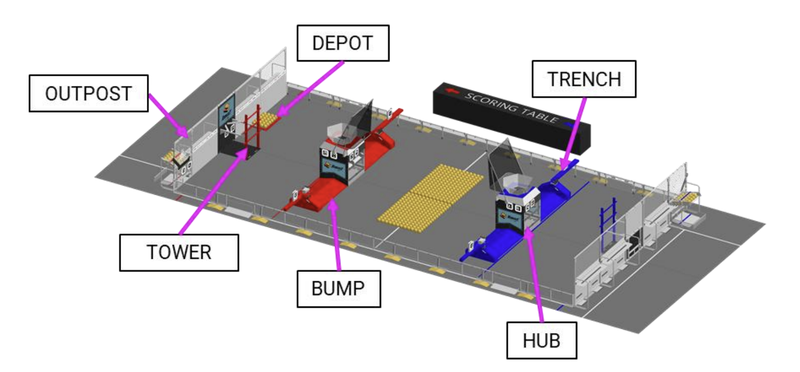
An FRC match involves two alliances competing against each other on two different color teams: red and blue. Each alliance contains three teams’ robots each, so a match would look like three red robots versus three blue robots.
Traditionally, an FRC match is broken into three different portions: autonomous, teleop, and endgame. Autonomous is the first twenty seconds of the match, where a robot moves completely on its own using the power of coding and AI, created by high school students. The next portion of the game is called teleop, where both alliances pick up the controllers and drive the robot around, scoring or playing defense. Endgame is the last portion of a match, where in the final thirty seconds, robots transition into their final positions.
Now you’re familiar with the basics of match composition, let’s DIG into REBUILT!
Game Elements:
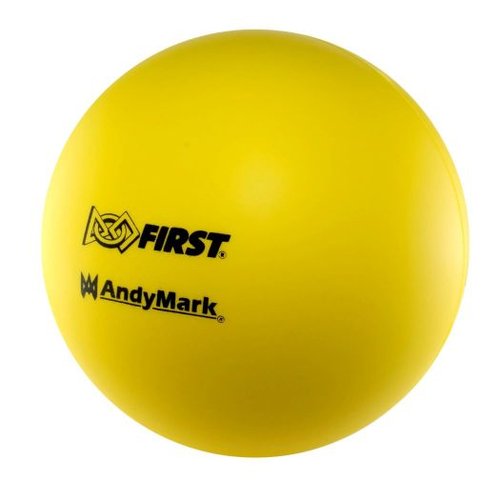
- Fuel: Yellow ball (Pictured left.)
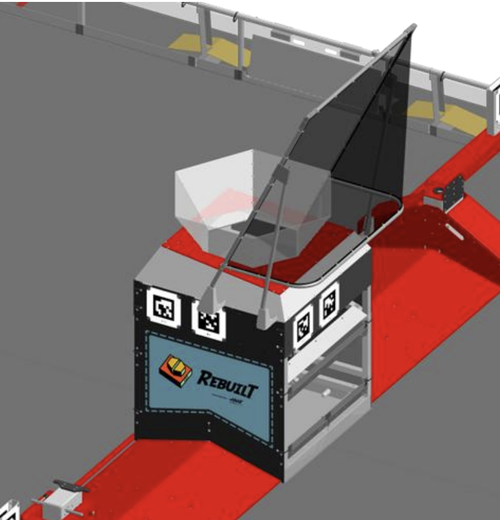
- Hub: The place where balls are shot into and scored from. (Pictured to the right below.)
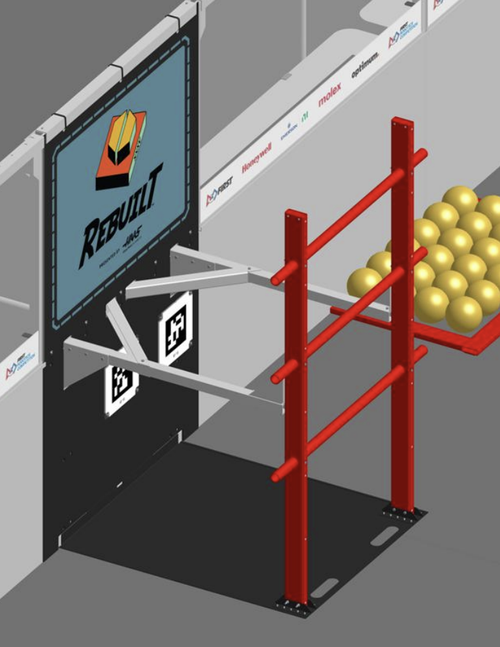
- Tower: The ladder-like structure robots hang from. (Pictured to the left below.)
Autonomous: The pre-programmed period
During the autonomous portion of the match, we focus on different combinations of tasks that lead to scoring points for our alliance.
Ways to Score During Autonomous:
- Scoring Fuel = 1 point per ball
- Climbing the Tower = 15 points per robot hanging on the first level (max 2 robots)
Teleop: The driver-controlled period
At the end of the twenty seconds of the autonomous period, we move into the transition period, which lasts ten seconds, where drivers are allowed to pick up their controllers and continue maneuvering their robot and scoring points.
Next comes the twist that makes this game different than previous seasons. Depending on how many points scored in the autonomous period determines which team’s hub is deactivated first, meaning when balls are shot into the hub, they don’t receive points. This means whichever team scores the most points with fuel (the balls) has its hub deactivated first. The team that scores the least starts with the hub activated, meaning the balls shot into it receive points.
Alliances then take turns during the teleoperated period (teleop) with activated and deactivated hubs, which last in shifts of twenty-five seconds. Each team has two shifts with their hub activated and two shifts with it deactivated.
Here’s an example of how the shifts would work in a match displayed in the table below:
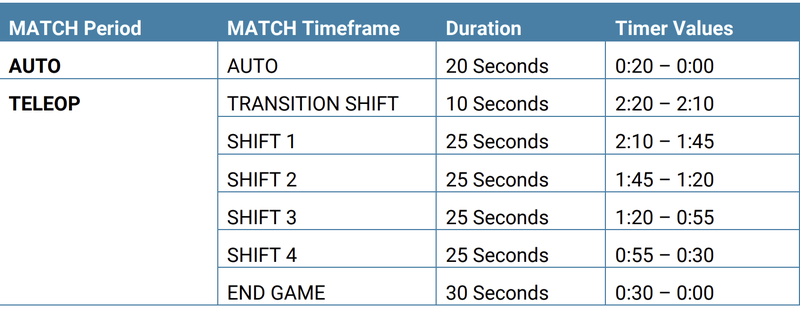
During teleop, the ways to score are the same. Every successful shot fuel ball into the hub earns one point each.
Endgame: The final thirty seconds of a match
At the end of a match, robots have another opportunity to score points other than shooting fuel into the hub; however, they may keep scoring fuel instead or do it in combination with other tasks.
Ways to Score During Endgame:
- Shooting fuel into the hub = 1 point per ball
- Climbing the Tower = 10 points per robot on level 1, 20 points per robot on level 2, and 30 points per robot on level 3
(Level one is the bottom rung pictured to the right, and the levels increase as you go up the tower.)
At the end of a match, the judges tally up all of the points scored to determine which alliance is the winner; however, there’s also another type of points: ranking points. Ranking points are awarded to an alliance after a match if they’ve completed the requirements of the ranking point task or if they win or tie in a match.
These are important to earn during qualification matches because this is the first statistic that determines the ranking of a team at a competition, which is helpful later when alliances are picked.
Types of Ranking Points:
- Energized: If an alliance scores enough fuel into the hub (currently, the number is 100, but it may change throughout the competition season).
- Supercharged: If an alliance scores enough fuel into the hub (currently the number for this particular ranking point is 360, but it may change throughout competition season).
- Transversal: If an alliance scores enough points by hanging on the tower during both autonomous and endgame combined (currently the number is 50, but it may change throughout competition season).
- Winning: An alliance receives three ranking points for winning a match.
- Tie: Both alliances receive one ranking point for tying a match.
An overview of the scoring and ranking points is listed below:
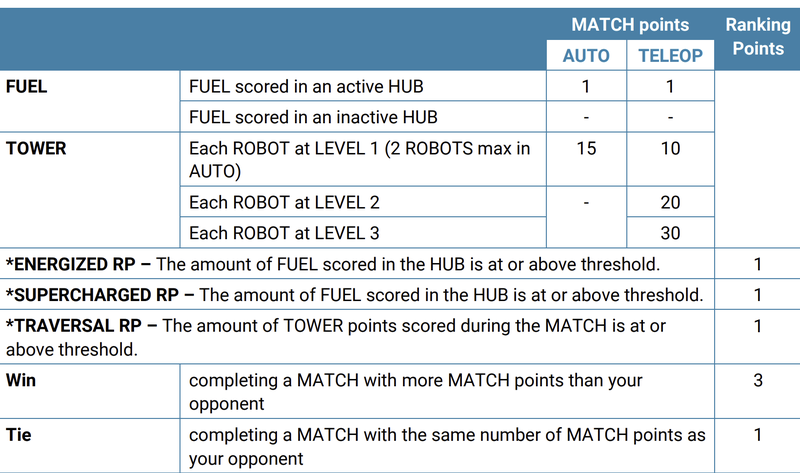
To learn more about the game, refer to both the game reveal video (pictured below) and the game manual.
Hopefully, this gives you a better understanding of the tasks we’re tackling for this year’s season. Stay tuned for updates on this entire process!